
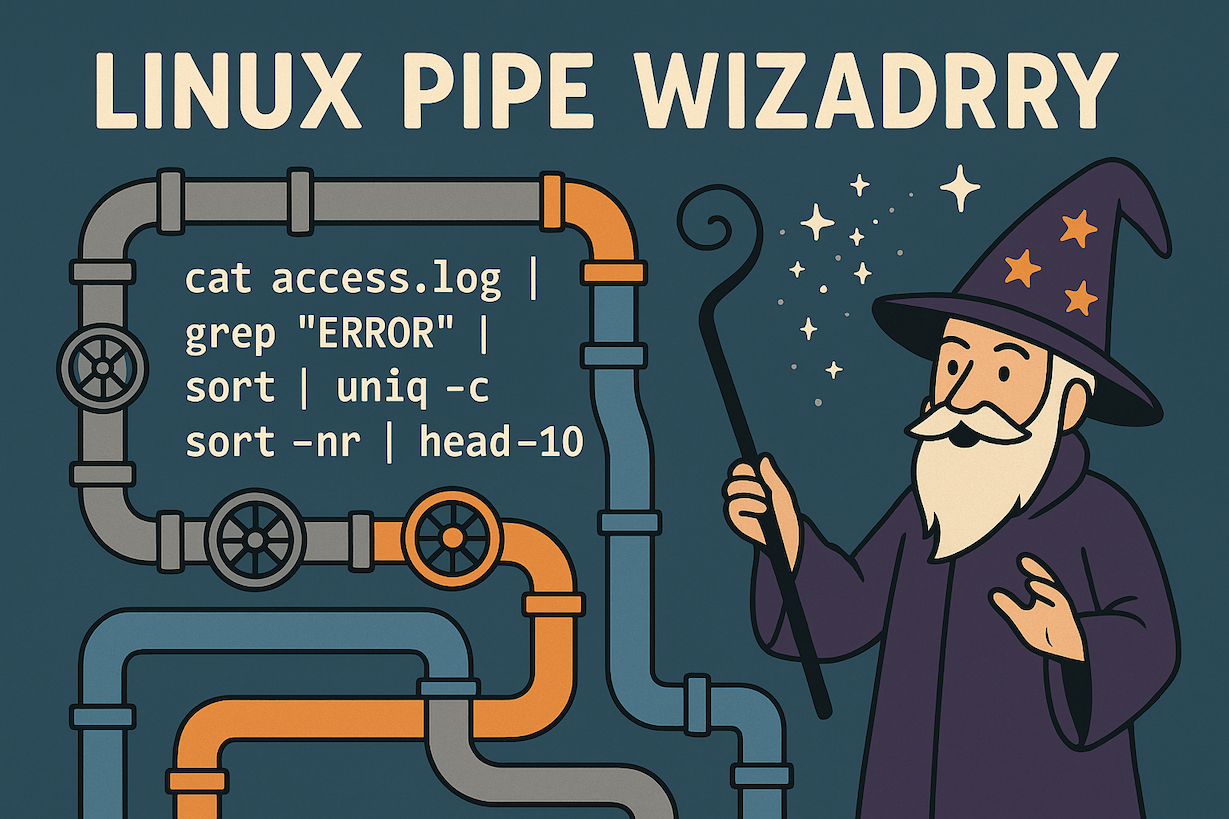
When working in Linux, one of the most powerful tools at your disposal is the pipe (|). It allows you to chain commands together, passing the output of one command directly as the input to another. This simple concept unlocks incredible flexibility and efficiency, transforming the command line into a dynamic problem-solving environment.
For example:
cat access.log | grep "ERROR" | sort | uniq -c | sort -nr | head -10
This single line of shell wizardry:
- Reads a log file (cat access.log)
- Filters only error messages (grep “ERROR”)
- Sorts them (sort)
- Counts unique occurrences (uniq -c)
- Sorts by frequency (sort -nr)
- Displays the top 10 (head -10)
Instead of writing a script with loops and conditionals, a pipeline lets you achieve the same result with clarity and elegance.
Why Pipes Matter
- Simplicity: Break complex tasks into small, reusable commands.
- Efficiency: Process streams of data without creating temporary files.
- Creativity: Combine tools in ways their authors may never have imagined.
Pipes are the secret ingredient behind the Linux philosophy: do one thing well, then connect the pieces. Once you master them, you’re no longer just a user—you’re a Linux pipe wizard.